

Movement Competency Continuums
Movement competency is a multifaceted construct integral to the long-term athletic development of youths.

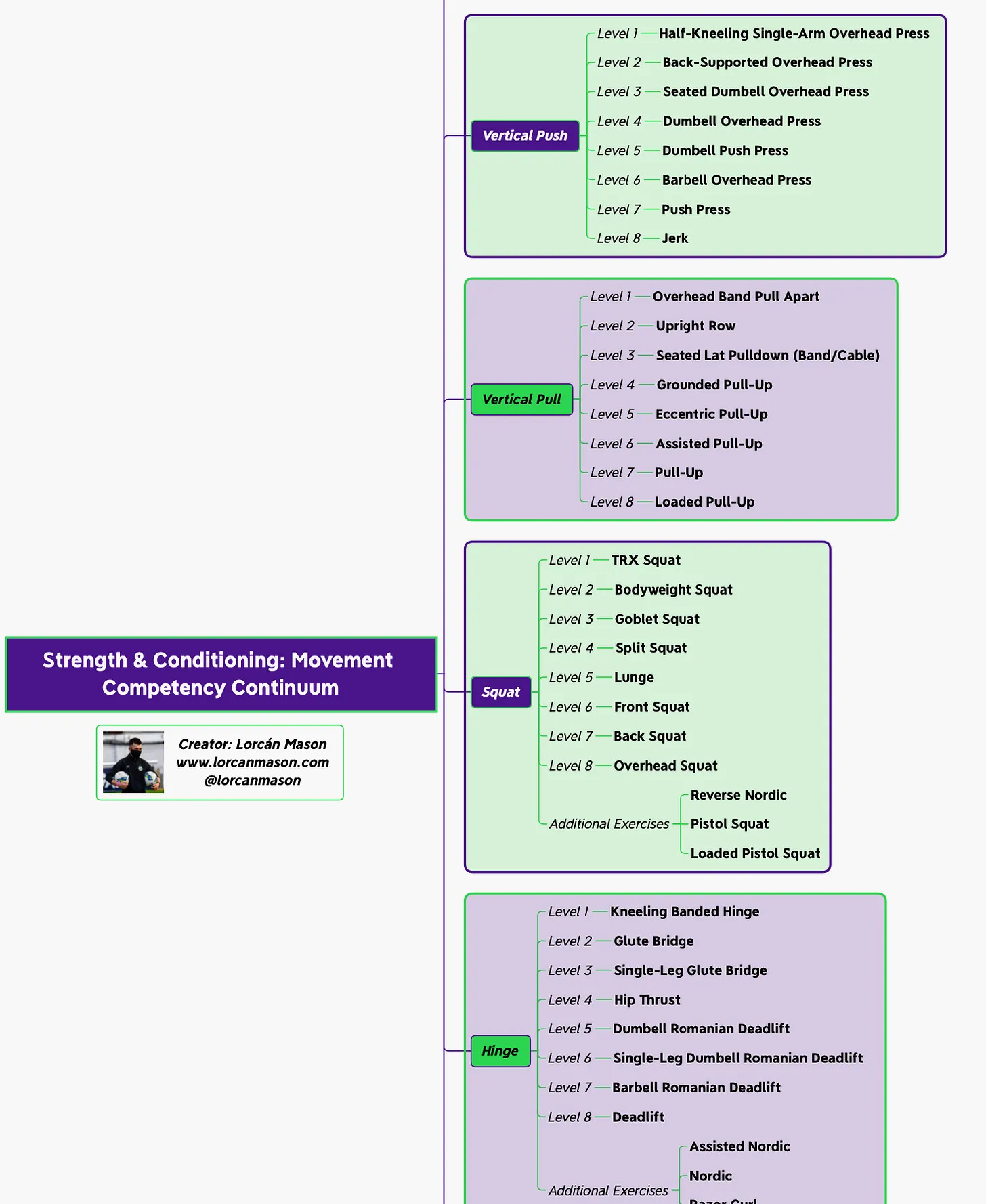
Movement competency is a multifaceted construct integral to the long-term athletic development of youths. It encompasses the ability to perform goal-directed tasks requiring controlled and coordinated bodily movements. This competency is multi-dimensional, comprising simple capacities such as balance, coordination, and flexibility, combined abilities like agility (dependent on flexibility, balance, and coordination), and complex skills such as hand-eye coordination and spatial orientation, all of which exhibit inter-relatedness (Whitehead, 2010).
The developmental trajectory of motor competency is theorised to be sequential during early childhood. Stability skills (e.g., balance) typically precede the development of locomotive skills (e.g., running), which are subsequently followed by object control skills (e.g., catching). Establishing a robust foundation in these fundamental stages is critical for the acquisition of more advanced and sport-specific movements in later developmental periods.
The cultivation of strong movement competency in youth athletes yields substantial benefits with implications for both athletic performance and overall well-being:
Enhanced Physical Activity Levels: Research indicates a positive association between higher motor competency and increased engagement in physical activity.
Improved Health Outcomes: Motor competency has been linked to healthier weight status throughout childhood.
Positive Impact on Physical Fitness: The development of motor competence contributes favourably to various facets of physical fitness, including musculoskeletal strength and endurance, alongside cardiorespiratory endurance.
Potential for Injury Risk Reduction: Proficient and controlled movement patterns may contribute to improved biomechanics and body control, thereby potentially mitigating the risk of injuries sustained during sports and physical activity.
Facilitation of Athleticism: As a foundational element, motor competency underpins overall athleticism, streamlining the learning and mastery of sport-specific skills.
Augmented Confidence and Perceived Competence: Experiencing competence in movement can enhance self-confidence in young individuals, fostering sustained participation in physical pursuits.
Conversely, a deficit in motor competency can engender a "proficiency barrier", whereby reduced skill levels during childhood can lead to diminished motor competency, physical activity participation, and physical fitness into adolescence and adulthood. Young individuals with less developed motor skills may exhibit a tendency to avoid physical activities due to perceived inadequacy, thus initiating a negative feedback loop characterised by reduced practice and further skill deterioration. Notably, studies have identified deficiencies in fundamental movement skills such as sprinting and squatting among adolescent athletes, potentially indicating insufficient emphasis on foundational development. As highlighted, an initial emphasis on fundamental movement techniques, including the squat and hip-hinge, is paramount prior to advancing to strength-focused training regimens (McQuilliam et al., 2020).
Strength and conditioning (S&C) coaches are increasingly recognised as key stakeholders in the delivery of interventions aimed at developing motor competency in youths. Various conceptual frameworks have been proposed to guide practitioners in the design and implementation of such interventions, including:
Fundamental Movement Skills (FMS).
Foundational Movement Skills.
Athletic Motor Skill Competencies (AMSC).
Structured S&C interventions have demonstrated the capacity to improve motor competency in youth populations. Effective developmental strategies encompass planned and structured interventions, deliberate practice, provision of constructive feedback, and clear instructional guidance.
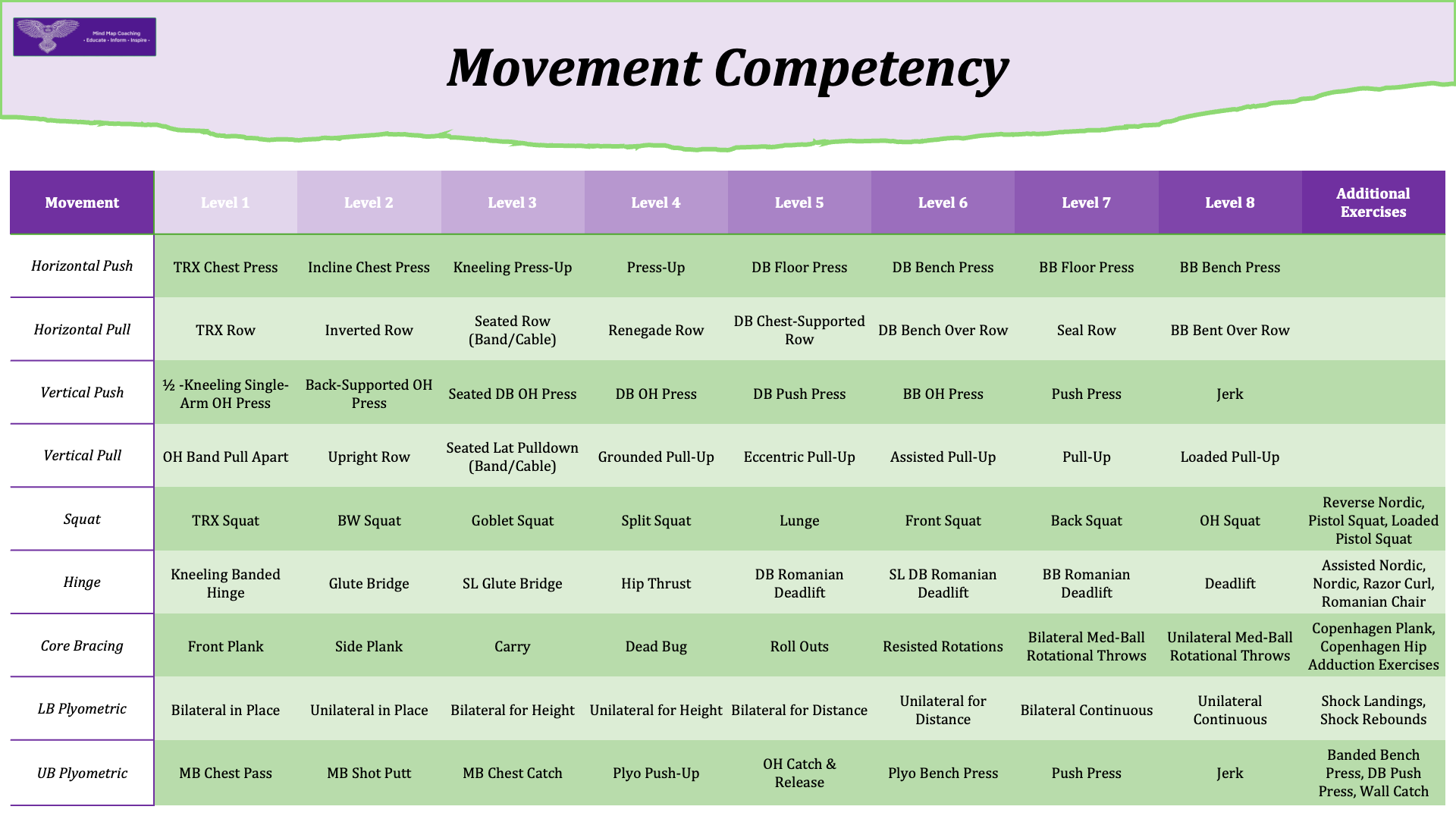
Research provides empirical insights into the perceptions and practices of S&C coaches concerning motor competency development in youths (Burton et al., 2021). Their findings indicate a potential disconnect between the perceived importance and the frequency with which certain motor competencies are targeted in practice. For instance, while "deceleration" was rated as the most important motor competency, "hip hinge (bilateral)" was the most frequently practiced. Furthermore, upper body pushing and pulling competencies were targeted more frequently than their perceived importance, while agility competencies (e.g., turning) received less emphasis than deemed important.
The study also revealed that session frequency, but not session duration, significantly influenced the number of motor competencies that coaches "frequently developed". Coaches delivering 3–4 sessions per week targeted 15–18% more competencies compared to those delivering ≤ 2 sessions per week. This suggests that practitioners with limited contact time should explore supplementary strategies to address less frequently targeted yet important motor competencies.
Drawing on these insights, practical applications for coaches and practitioners include:
Critical Reflection on Coaching Practices: Practitioners should systematically evaluate the motor competencies they prioritise in their training programmes and compare this against the perceived importance of various skills for their athletes' developmental needs.
Consideration of Biological Maturity: Training programmes should be appropriately tailored to the biological and psychosocial maturity status of the young athletes. The importance of considering maturity status when designing resistance training programmes is paramount (McQuilliam et al., 2020).
Integration of the AMSC Approach: Focus on developing movement competencies that are directly transferable to athletic tasks, encompassing attributes such as force production, load attenuation, and core stability.
Implementation of Microdosing Strategies: Incorporating short, frequent exposures to less frequently targeted but important motor competencies, potentially within warm-up routines, can enhance overall development. Frameworks such as RAMPAGE (Raise, Activate, Mobilise, Prepare, Activity, Games, Evaluate) offer a structured approach to warm-ups that can target a broad spectrum of motor skills.
Prioritisation of Fundamental Movements in Resistance Training: As evidenced, establishing proficiency in foundational movements like squats and hip hinges is a prerequisite for progressing to more complex or heavily loaded resistance exercises, as strength developed in these fundamental patterns underpins power development (McQuilliam et al., 2020).
In conclusion, the development of movement competency is a crucial element in the holistic development of youth athletes, impacting not only their athletic potential but also their long-term health and engagement in physical activity. By understanding the multifaceted nature of motor competency, its developmental underpinnings, associated benefits and detriments, and the practical application of competency frameworks informed by research, practitioners can optimise their coaching strategies to ensure a robust foundational development for young athletes. Continued inquiry into coach education and the longitudinal impact of motor competency interventions remains paramount for advancing best practices in youth athletic development.

References
Burton, A. M., Eisenmann, J. C., Cowburn, I., Lloyd, R. S., & Till, K. (2021). Developing motor competency in youths: Perceptions and practices of strength and conditioning coaches. Journal of Sports Sciences, 39(23), 2649–2657. https://doi.org/10.1080/02640414.2021.1949189
McQuilliam, S.J., Clark, D.R., Erskine, R.M. et al. (2020). Free-Weight Resistance Training in Youth Athletes: A Narrative Review. Sports Med 50, 1567–1580. https://doi.org/10.1007/s40279-020-01307-7
Whitehead, M. (2010). Physical literacy: Throughout the lifecourse. Routledge.